The Moment Everything Falls Apart
Last month I watched three years of work collapse in a single afternoon. The mobile app I’d been building with my team just… died. Not from some dramatic server crash or catastrophic bug. It died from something much quieter and more devastating: nobody wanted it.
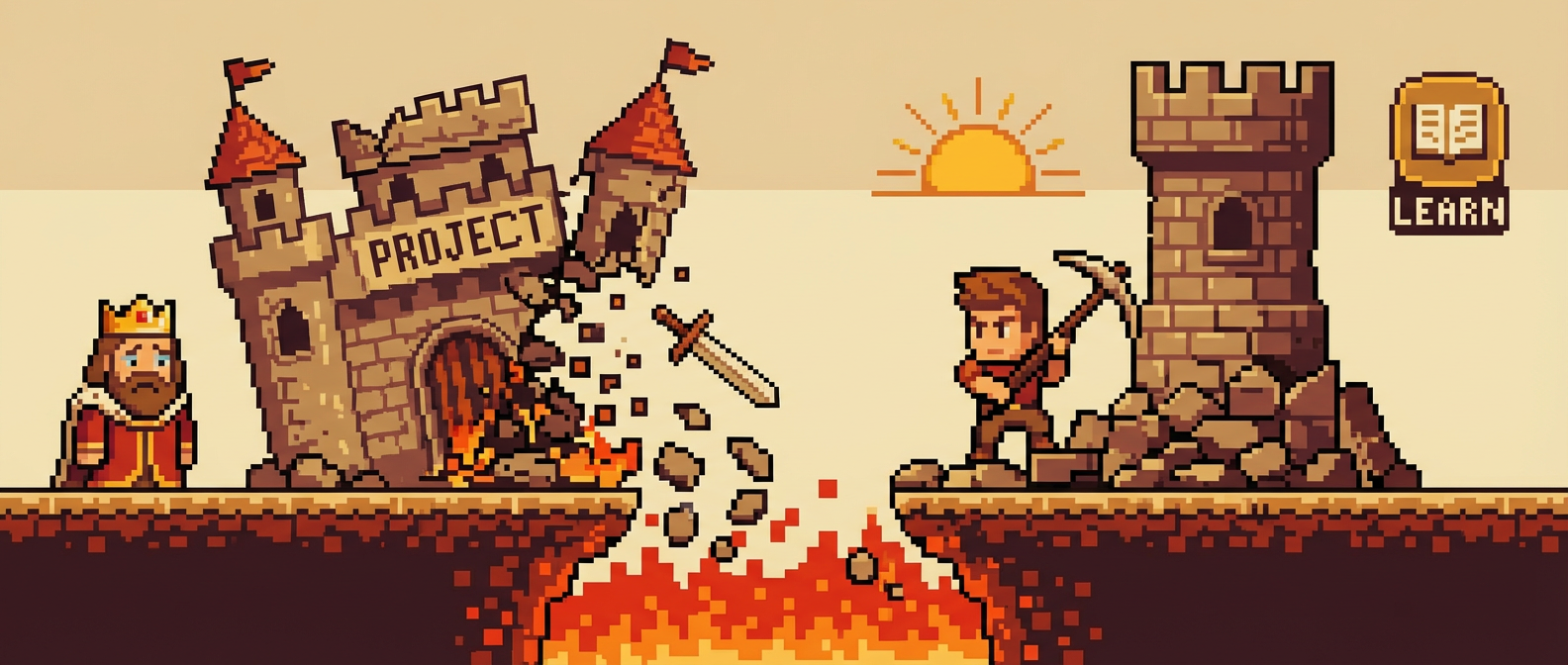
We’d followed every rule in the startup playbook. Market research? Check. User interviews? Dozens. Minimum viable product? Built and shipped. But somehow we’d created something that solved a problem nobody actually had. The download numbers told the story in brutal clarity: 47 users in week one, 12 in week two, and by month three we were down to my mom and two very patient friends.
Here’s what I noticed in that moment of recognition. The failure itself wasn’t the hard part. It was realizing how much I’d been lying to myself along the way.

The Stories We Tell Ourselves While Things Crumble
Project failures have this weird timeline. They don’t just suddenly appear one day like a flat tire. They build slowly, with tiny warning signs that are incredibly easy to ignore when you’re deep in the work.
For our app, the first red flag was how hard it became to explain what we were building. When people asked about it at parties, I’d launch into these long, complicated explanations that always ended with confused nods. But instead of seeing this as a signal that maybe our core concept was off, I told myself we just needed better messaging.
The second flag was how our user interviews started feeling forced. People would say our prototype was “interesting” and “could be useful” but nobody ever asked when they could download it. Nobody ever said they’d been looking for exactly this thing. But we interpreted politeness as validation and kept building.
The third flag was the most obvious one: we stopped showing the work to people. When you’re excited about something, you can’t shut up about it. When you’re worried it might not work, you suddenly become very protective of your “stealth mode” approach.
What Failure Actually Teaches You (Spoiler: It’s Not What You Think)
Everyone talks about learning from failure like it’s this noble, character-building experience. And sure, there’s some truth to that. But the real learning isn’t what most people expect.
The obvious lesson from our app failure should have been “validate your market earlier” or “listen to user feedback more carefully.” Those are good lessons, and I definitely learned them. But the deeper lesson was about recognizing the difference between persistence and stubbornness.
I’d always prided myself on being persistent. Never giving up. Pushing through obstacles. But somewhere in those three years, persistence had quietly transformed into something else entirely. I was no longer solving problems; I was just refusing to admit that the original premise might be wrong.
The shift is subtle but important. Persistence says “this is hard, but we can figure it out.” Stubbornness says “this has to work because we’ve already invested so much.” One opens up new possibilities. The other closes them down.
The Hidden Cost of Almost-Success
Here’s something weird I noticed: the projects that fail dramatically are often easier to recover from than the ones that almost work.
When something crashes and burns immediately, you know exactly where you stand. It hurts, but it’s clean. You mourn it, learn from it, and move on. But when a project lingers in that liminal space between “not quite working” and “maybe we can save this,” it becomes much harder to let go.
Our app never completely failed. We had those 12 loyal users. We had some positive reviews. We had moments where the metrics ticked upward and we thought maybe we were turning a corner. Those little wins became anchors that kept us stuck to something that fundamentally wasn’t working.
I spent months in what I now think of as “zombie project mode.” Still working on it, still believing in it, but with this growing sense that we were just going through the motions. The project wasn’t alive enough to thrive, but it wasn’t dead enough to bury.
The Questions That Actually Matter
Looking back, I think the most valuable thing I learned wasn’t about app development or market research. It was about asking better questions while I’m still in the middle of things.
Instead of “How can we make this work?” I learned to ask “What would have to be true for this to work?” Instead of “How do we get more users?” I started asking “Why don’t people want this?” Instead of “What features should we add?” I began wondering “What problem are we actually solving?”
The hardest question, though, was this one: “If I were starting this project today, knowing what I know now, would I start it?” It’s brutal because it cuts through all the sunk cost fallacy and emotional investment and forces you to evaluate the idea on its current merits.
For our app, the honest answer was no. I wouldn’t have started it. That realization hurt, but it was also liberating. It gave me permission to stop.
These days I’m working on something completely different. A newsletter about local food systems that started as a side project and somehow gained 2,000 subscribers in six weeks. People actually forward it to their friends. They reply to tell me which restaurants they tried based on my recommendations. It’s the opposite of my app experience in every way.
I’m still not sure if this new project will work long-term, but I know the feeling is different. And maybe that’s the real skill failure teaches you: how to recognize what authentic momentum feels like, so you can tell when you’re working with the current instead of against it.