January’s Ambitious Disasters
I started this year convinced I’d crack the code on pottery. Not just make decent bowls, but actually understand why some pieces sang and others looked like sad mushrooms. My first ten attempts collapsed in the kiln. The eleventh cracked down the middle. Number twelve looked promising until I glazed it with what I can only describe as the color of regret.
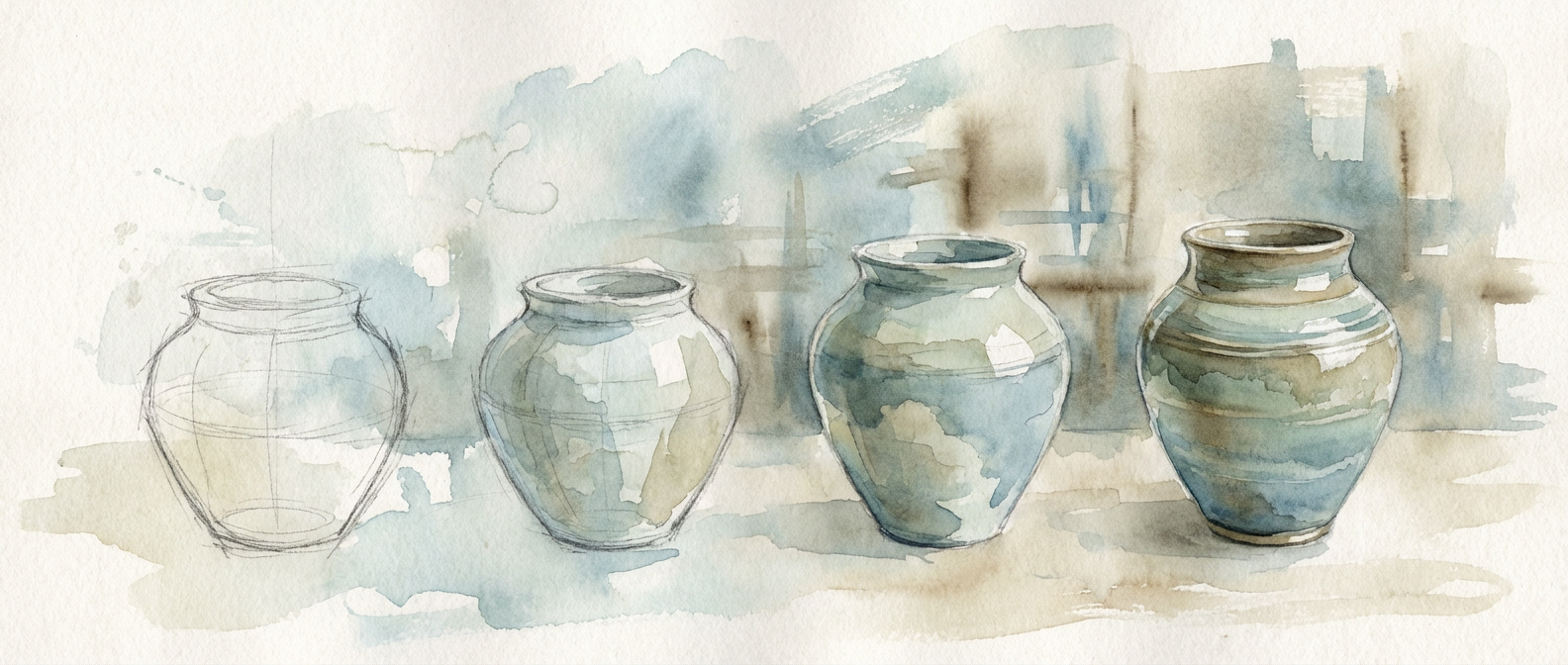
Here’s what nobody tells you about iteration: the early failures don’t feel like learning. They feel like proof you’re terrible at this. I threw away more clay in January than I kept. My hands were raw from wedging. I questioned every choice, from the clay body to my life decisions that led me to a pottery studio at 7 AM on a Tuesday.
But something shifted around piece fifteen. Not mastery, God no. Just the tiniest recognition that my hands knew something they hadn’t before. The clay felt different under my palms. I stopped fighting the wheel and started having conversations with it instead.

The Deceptive Comfort of Spring Progress
March through May felt like victory laps. I was making bowls that held soup without leaking. People started saying encouraging things. I got cocky and decided to attempt a teapot because clearly I was ready for advanced pottery wizardry.
The teapot taught me humility in seventeen different ways. The spout drooped like a disappointed elephant. The handle attached at an angle that defied both physics and common sense. When I tried to pour water, it dribbled down the side in what I generously called “rustic charm” but was actually just poor craftsmanship.
I made eight teapots that spring. Five collapsed. Two leaked from mysterious locations. One actually worked but looked like something a drunk octopus might design. The process felt less like building skill and more like archaeology, excavating tiny improvements from layers of spectacular failure.
Summer’s Unexpected Teacher
July brought a heatwave and a broken air conditioner in the studio. Working in 95-degree heat with clay that dried faster than I could shape it should have been miserable. Instead, it became my most productive month.
The heat forced me to work faster, with less second-guessing. No time for perfectionist paralysis when your vessel was hardening in real time. I learned to commit to shapes, to trust my first instincts instead of fussing everything into mediocrity. The constraints made me better, not worse.
I also discovered the magic of accepting warping. Those slightly wonky bowls that emerged from the fast-drying clay had character that my careful, symmetric pieces lacked. Imperfection wasn’t the enemy of craft, it was often the source of its personality.
By August, I was making pieces I actually wanted to keep. Not because they were perfect, but because they felt alive in ways that my technically superior but soulless early work never did.
The Fall Plateau Nobody Warns You About
September hit like a creative wall. I could make competent bowls in my sleep. My muscle memory had crystallized around certain forms and techniques. I was skilled enough to be consistent but not skilled enough to break into new territory without significant struggle.
This plateau phase is where most people quit, though nobody talks about it. The beginning has the excitement of rapid improvement. The advanced stages have the satisfaction of mastery. But the middle, the long frustrating middle, tests whether you actually love the process or just the progress.
I spent October making deliberately bad pieces. Wonky proportions, experimental glazes, techniques I’d read about but never tried. Half my kiln loads were disasters. But buried in the wreckage were sparks of something new. A handle attachment that surprised me. A glaze combination that shouldn’t have worked but did.
November brought the breakthrough I didn’t know I needed. Not a perfect piece, but an ugly mug with a handle that felt exactly right in my hand. The proportions were off. The glaze was muddy. But when I held it, everything clicked. I finally understood that craft isn’t about making beautiful objects, it’s about making objects that work with intention.
December’s Honest Accounting
Looking back through photos of this year’s work, the progression isn’t linear. It’s more like a drunken spiral toward competence, with detours through disaster and unexpected discoveries in dead ends. My December pieces aren’t universally better than my March ones. But they’re more intentional. More me.
The real lesson isn’t about pottery at all. It’s about how craft develops in the spaces between success and failure, in the willingness to show up when the work feels impossible and when it feels too easy. Most improvement happens in the margins, the adjustments you make when piece 47 cracks differently than piece 46.
I still make terrible pots sometimes. The difference is I can now tell the difference between terrible because I’m learning something new and terrible because I’m being lazy. Both have their place, but only one moves you forward.
What projects are you wrestling with in the messy middle? I’d love to hear about your own experiments and failures. The honest ones, not just the highlight reel. Sometimes knowing you’re not the only one elbow-deep in beautiful disasters is exactly what you need to keep going.