Opening the Vault of Creative Carnage
I just flipped through my process notebook from three months ago. Page after page of half-baked ideas, crossed-out sketches, and enthusiastic plans that never saw daylight. There’s the pottery wheel I convinced myself I needed for “mindful creating.” The 30-day video series that died on day four. The ambitious short story collection that became three paragraphs about a woman who talks to houseplants.
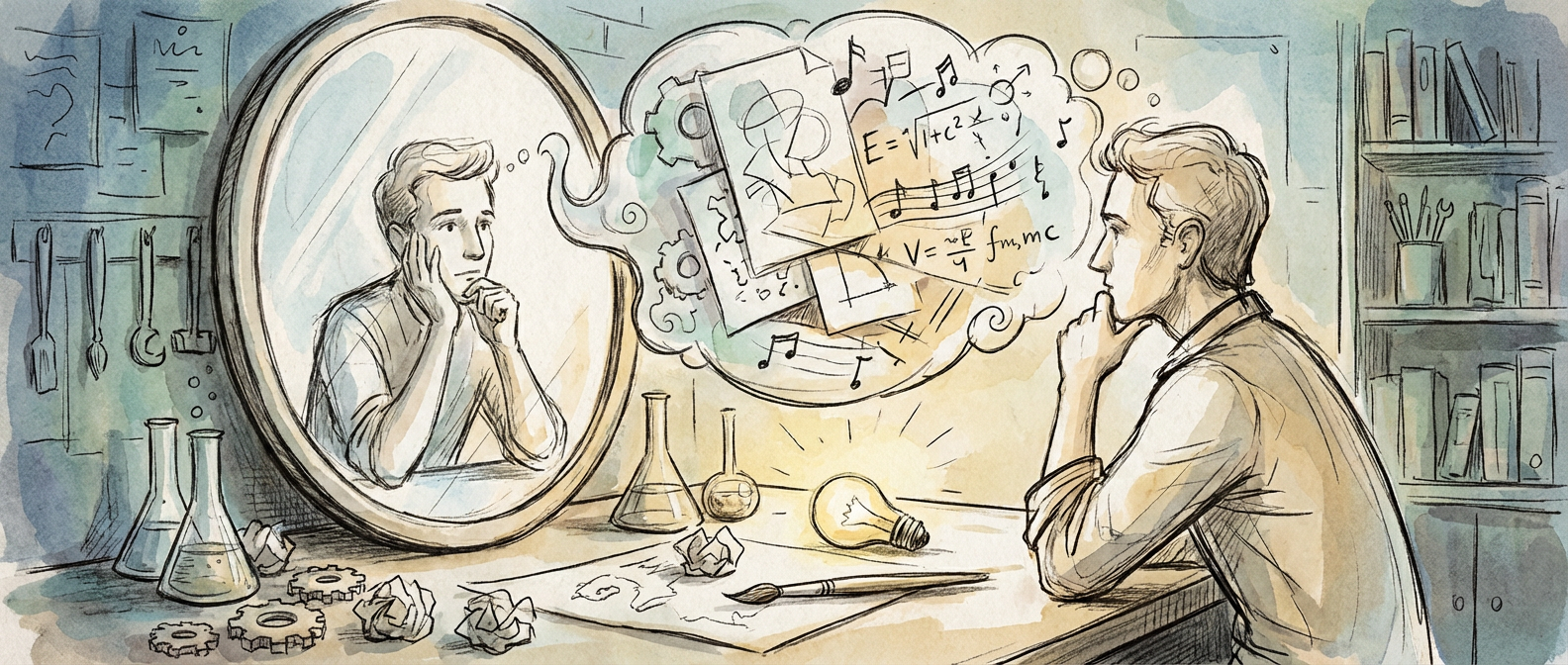
Here’s what nobody tells you about creative experiments: most of them fail spectacularly. And that’s not just okay, it’s necessary data. Every abandoned project teaches you something about how your creative brain actually works versus how you think it should work.
My notebook isn’t pretty. It’s messy, contradictory, and occasionally has grocery lists wedged between breakthrough moments. But it’s honest. And honestly? That makes it more valuable than any polished portfolio piece I’ve ever produced.

The Graveyard of Great Intentions
Let me show you some specific casualties. Project one: “Daily watercolor studies of shadows.” Lasted six days. I discovered I hate cleaning brushes more than I love painting. Lesson learned: factor maintenance into any creative practice, because the boring parts will kill your momentum faster than lack of inspiration.
Project two: “Write one haiku every morning for a year.” Made it to February 12th. Turns out forcing poetry at 6 AM while half-caffeinated produces gems like “Coffee cup empty / My brain feels like cold oatmeal / Tuesday is stupid.” Not exactly Basho material.
But here’s the twist. That failed haiku experiment led to something better. I started writing terrible poems about mundane frustrations. Really terrible. Like, aggressively bad. And those terrible poems became the voice for a humor newsletter that now has actual subscribers who actually read it.
The pottery wheel? Still collecting dust. But the reason I wanted it, craving tactile, hands-on creating, led me to bread baking. Which led to documenting the science of sourdough starters. Which became a series of blog posts that taught me more about my writing process than any writing workshop ever did.
Learning to Autopsy Your Creative Corpses
The trick isn’t avoiding failure. It’s learning to autopsy your creative corpses without getting depressed about the body count. I’ve developed a simple post-mortem process: What killed this? What part did I actually enjoy? What would I do differently if I tried again?
That video series I abandoned? Died because I tried to script everything perfectly before filming. But the two minutes of improvised talking I captured while testing my camera setup had more energy than hours of scripted content. Now I know: for me, spontaneity beats perfection every time.
The short story collection taught me I’m better with character voices than plot structure. So instead of forcing narratives, I started writing character monologues. They’re weird and don’t fit any genre, but they feel authentic in a way my plotted stories never did.
Sometimes the real experiment isn’t the thing you thought you were testing. I thought I was experimenting with different creative mediums. Turns out I was experimenting with different versions of myself as a creator. The pottery attempt revealed I need immediate visual feedback. The haiku failure showed me I work better with humor than gravity. The video project taught me to trust my unpolished voice.
The Uncomfortable Truth About Creative Consistency
Here’s where I’m going to tell you something you probably don’t want to hear: consistency isn’t about doing the same thing every day. It’s about consistently showing up to figure out what works for you, even when, especially when, what you’re trying isn’t working.
I used to think successful creators had it all figured out. That they found their medium and their voice and just stayed there. But the more I study creative people I admire, the more I see they’re constantly pivoting, adapting, scrapping projects, starting over.
Maya Angelou wrote her first book on yellow legal pads lying on her bed. Terry Pratchett wrote his first novel on a typewriter. Then computers happened. Stephen King wrote Carrie on a typewriter in a trailer and almost threw it away. J.K. Rowling wrote Harry Potter by hand in cafes. Every creator adapts their process as they learn what actually works for their brain, their life, their current circumstances.
Your creative process isn’t broken if it keeps changing. It’s adapting. The experiments that fail aren’t wasted time, they’re research. You’re figuring out the specific conditions under which your creativity thrives.
Building Your Own Laboratory
So how do you experiment without drowning in unfinished projects? Start small. Stupidly small. Instead of “I’ll write a novel,” try “I’ll write one paragraph about this weird thing I noticed today.” Instead of “I’ll learn oil painting,” try “I’ll make a mark with paint and see what happens next.”
Set a maximum time limit. Some of my best discoveries came from 20-minute experiments that had to end whether I wanted them to or not. Time constraints force you to start before you’re ready and stop before you overthink.
Document everything, especially the failures. Not just what you made, but how it felt to make it. Did time disappear? Did you fight yourself the whole way? Did you surprise yourself? These observations are your real data.
And here’s the big one: share your experiments while they’re still messy. Find one person who’s also figuring things out and trade failed experiments. There’s something magical about realizing you’re not the only one with a graveyard of abandoned projects.
I’m curious about your creative graveyard. What experiments are you avoiding because they might not work? What’s sitting unfinished because it doesn’t match what you thought it would be? Sometimes the best discoveries happen when we stop trying to prove we’re good at something and start investigating what happens when we’re genuinely curious about something. What are you curious about right now?